
Participation Project in Water Management in Bueng Boraphet Wetland
- Impact Partnership

- Nov 21
- 9 min read
Project Owner: Research and Academic Services Center, Nakhon Sawan Campus Establishment Project, Mahidol University









🔹1. Case Overview
Area of operation
Bueng Boraphet wetland area, Nakhon Sawan Province, which covers 9 sub-districts in 3 districts, with 5 pilot sub-districts as water user organizations and expanding to 4 more sub-districts.
Processing time
September 2021 – December 2022
Problems / Opportunities
Violent conflict:Intense competition for water among user groups (such as farmers and fishermen), especially during the dry season when raw water is insufficient.
Structural complexity:There are three overlapping laws and 13 related agencies, making management fragmented.
Ecological degradation:The problem of shallowing from sediment and inefficient pumping of water from the Nan River into the lake, this project aims to create"Water Use Rules"That all parties agree on, using a participatory process based on scientific data and local facts as a basis for negotiations.
Impact Verifier Status
This project has passed the Social Return on Investment (SROI) assessment.
by Thai Social Valuers Association (Social Value Thailand)
Assessment completed in October 2025
The evaluation results found that an investment of 1 baht creates a social return of 28.89 baht (SROI Ratio =28.89)
🔹 2. Stakeholder Mapping (Stakeholder Identification)
Stakeholder groups | role | Benefits received (or affected) | Participation level | |
Community / Main Target Group | Water User Organization (WUO) 9 sub-districts, 5 pilots and 4 expansions | Key beneficiaries, co-creators, bottom-up drivers | Social aspect:Reduce conflicts in water use (complaints decreased by almost 100%), create social capital and pride, have negotiation power, access transparent information through Line OA. Economic:Reduce concerns and create stability in agricultural land (entering the Treasury Department's rental system for 5,000+ households), reduce impacts and damages to occupations (agriculture/fishing/tourism), reduce costs (water costs, fertilizer costs from alternating wet and dry fields), increase income (e.g. tourism) Environmental:Benefit from improved water quality (from category 4 → 3) and a recovered ecosystem from water level maintenance. | Very high Co-driver and decision maker |
People in the area, more than 5,684 households around the lake
| Key beneficiaries, co-creators, bottom-up drivers | |||
Government agencies | Department of National Parks, Wildlife and Plant Conservation | Caretaker of Bueng Boraphet Wildlife Sanctuary | Management:Reduce conflict management costs and complaints, making it easier to integrate 13 departments (from previously working in separate units) Data side:Obtain current database (GIS/water usage) for planning, reduce communication costs/create understanding with the community. Operational aspects:(Treasury Department) has successfully allocated 100% of land in the prototype area, (National Park Department) has received proposals from the community to include in the "Conservation Plan", (ONWR) has received "Bueng Boraphet Model" as a Best Practice for expansion. | high (Paradigm shifters and policy makers) |
Treasury Department | Crown land owners | |||
Department of Fisheries | Traditional land users for aquatic animal breeding | |||
Royal Irrigation Department | Main Gate Manager | |||
Department of Water Resources | Water pumping supervisor for Boraphet Lake | |||
Office of National Water Resources | Policy agencies that oversee the overall picture | |||
Nakhon Sawan Province | Bueng Boraphet Management Committee (Main Board) | |||
Business sector / Supporting organizations | Mahidol University | Project sponsors | Create real world impact and enhance the institution's image (SDGs) | Very high (initiator, process creator, connector) |
Mahidol University (Nakhon Sawan Campus) | The initiator, main project operator, creator of the participatory process and acts as a coordinating "middleman". | Personnel (Mahidol University) are recognized and appointed as national committee members. | ||
Educational institutions/researchers | Nakhon Sawan Rajabhat University | Network of academic partners who collaborate on research | Reduce the cost of accessing data and networks in the area for research. Obtain a database to further research, write proposals, and develop teaching innovations (e.g., board games, integration into courses). | |
Civil society / networks |
🌐 Key points of emphasis:Highlighting the “ecosystem of collaboration”— Who really makes the results happen?
🔹 3. Intervention / Innovation (Strategy – Method – Tools used)
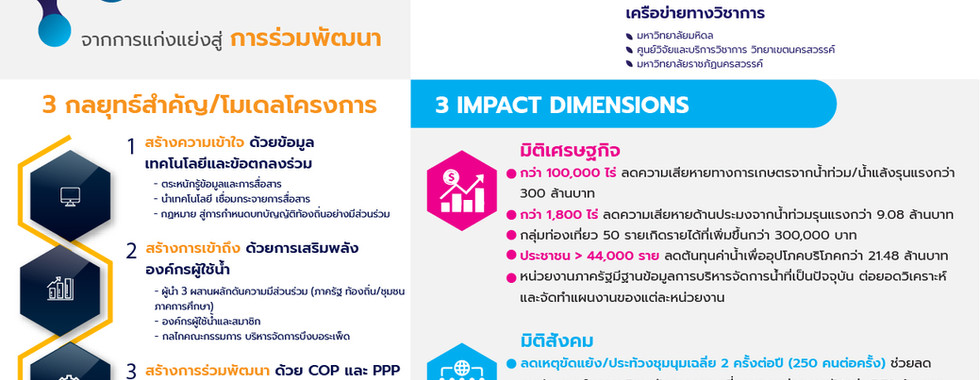
Innovation or working methods | Process Innovation: This project changes the way the area works from the traditional "Silo" and "State Directive" model to"Data-driven Co-management"Using the 3-Build Strategy |
| |
Strengths |
|
Draw a miniature model (Impact Model Diagram) : OPTIONAL**
Problem(conflict, lack of information, fragmented state) →Intervention(3 Creation: Creation of understanding, Creation of access, Creation of joint development) →Change(User organizations are formed, working groups are formed, joint rules are formed, land rights are obtained) →Value(SROI 28.89, 100% conflict reduction, improved economy, society, and environment) |
💡 Key points of emphasis:It shows that this project “changes the way of thinking or doing”, causing changes from the original.
🔹 4. Impact Pathway / Theory of Change (Path of Change)
Use a linkage modelInput → Activity → Output → Outcome → Impact
number | list | Example description |
Input | Resources, Team, Information | Main project budget (Mahidol University):995,000 baht Stakeholder Contributions (Y0-Y2):20.07 million baht (including community time, integrated government budget, and academic resources) |
Activity | Main activities |
|
Output | The resulting product |
|
Outcome | Qualitative change | society:Conflicts over water resources have decreased (complaints have decreased by almost 100%), and there has been a stronger relationship and integration (state-community). economy:Reduce the impact and damage to agriculture and fisheries. 5,000+ households have legally entered the land leasing system. environment:The water quality in the lake has improved (from type 4 → 3) and regulations have been put in place to maintain the water level (not less than +23.00 m. R.T.G.). |
Impact | Systemic/Sustainable Change | policy:The "Bueng Boraphet Water Management Working Group (Flood and Drought)" was established in Nakhon Sawan Province. law:The project proposals are included in the "Conservation and Protection Plan for Bueng Boraphet Wildlife Sanctuary Area (2022-2025)". Expansion:The Office of the National Water Resources and Environmental Policy and Planning Region 2 accepts the "Bueng Boraphet Model" as a "Best Practice". |
🌱 Key points of emphasis:Helps to see the actual “Impact Pathway” that the project is creating.
🔹 5. Evidence & Indicators (Evidence and outcome indicators)
Specify quantitative and qualitative results, such as:
Quantitative | Impact Breakdown: Economic dimension: 351.06 million baht (60.54%)
Environmental dimension: 183.23 million baht (31.60%)
Social dimension: 45.62 million baht (7.87%)
|
Qualitative | Reduce conflict:"Complaints were reduced by almost 100%" (Speech by the President of the Water Users' Organization) Government acceptance:The Treasury Department stated that "Bueng Boraphet is the first prototype area where land allocation has been successfully implemented 100%." Integration:There is a collaboration between 13 government agencies that were once separated. |
SROI / Economic Valuation | Rate of Return (SROI Ratio): 28.89(Invest 1 baht, create a social return of 28.89 baht) Total Impact Value (2021-2028): 579.92 million baht Total Investment Value (Total Input) (2021-2028): 20.07 million baht |
📊 Key points of emphasis:To show that results are “tangible” and reflect value, not just output.
🔹 6. SV Key Lessons Learned (Key Lessons / Success Factors)
Factors contributing to project success | 1. Data (Building Shared Understanding):Creating a “Shared Understanding” is the most important key to reducing conflict. 2. Process (Power from the Roots):Success is driven by bottom-up drive and the creation of strong "Water User Organizations (WUOs)". 3. Leadership (mediator role):Mahidol University (Academic Sector) acts as a neutral "facilitator" helping to connect the government and the community. 4. Partnership (mutual benefits):Designing a process that makes all parties aware of "Shared Incentives" creates true integration. |
Obstacles and lessons learned from operations | Overcoming Distrust:Initially, the community felt "traumatized" by the past research projects that were "just do it and go". The project needed time to build ongoing relationships. The complexity of the law:With 13 agencies and three overlapping primary laws, integration has failed in the past, and the project has relied on a "judicial ruling" (which states that all laws must be applied together) as the starting point for negotiations. External factors:The COVID-19 outbreak and flooding situation in 2021-2022 caused the field visit to be delayed from the plan. |
role | Leader (Mahidol University):Be an initiator, facilitator, knowledge and technology creator (Line OA) Network (Water User Organization):Be a problem owner, a co-creator of the rules, and a driving force in the area. Supporters (13 government agencies):Be a law-maker, a changer of attitudes, and a guarantor of new mechanisms to be put into practice. |
🔹 7. Impact Scalability
In summary, how can this process be “extended/expanded” to other areas? | This model is scalable using a 3-step strategy:
Policy Scaling:Office of National Water Resources (ONWR) Region 2 accepts "Bueng Boraphet Model" asBest Practiceand there is a plan to present it to expand to more than water user organizations3,000 organizations nationwide |
Project wants to expand cooperation. What to develop? Invite Impact Partnership. | 1. Climate Resilience:Expanding the "Alternating Wet and Dry (AWD) Model" to agricultural areas around the lake, inviting the private sector to join in creating market mechanisms and eco-friendly rice brands. 2. Technology:Develop the "SMART Bueng Boraphet" system to link APIs with databases of various agencies (e.g., the Royal Irrigation Department, the Department of Water Resources) 3. Sustainability (sustainability):Inviting local and educational sectors to join in promoting "New Generation Leaders" to participate in water user organizations to ensure continuity of the mechanism. |
🧩 Key points of emphasis:Let's see the "opportunity to further apply this model" and join hands.— Help the association select cases with high potential for public dissemination.
🔹 8. SV Inspiration (Reflection of social values)
“What value did this project create for people and society?”
This project has transformed the "battlefield" of resource competition into a "forum of cooperation" by building "trust" and "common rules" based on information and mutual understanding. The greatest value lies in restoring "rights" and "voices" to communities, enabling them to manage their own resources, while restoring ecosystems and ensuring land security. It proves that complex and long-standing problems can be resolved when all parties share a "mutual interest."
Reflected from the perspective of beneficiaries (stakeholder voice)
Short quotes (Quotes) from stakeholders such as villagers, researchers, local administrators
Short quotes (Quotes) from those involved | Researcher (Beginner):"The key is to create systems and mechanisms that lead to changing community attitudes. When communities participate, the system can function effectively before we can push for change at the policy and legislative level." -Dr. Napol Anutrangkul (Project Leader) Policy Sector (Expander):"The strength of the Bueng Boraphet model comes from its bottom-up drive. When all parties recognize shared incentives, it leads to true integration, not external organization." -Mr. Sarawut Sakon (Director of the NBTC Region 2) Government (Law Enforcer):
Community (beneficiaries):
|


Comments